
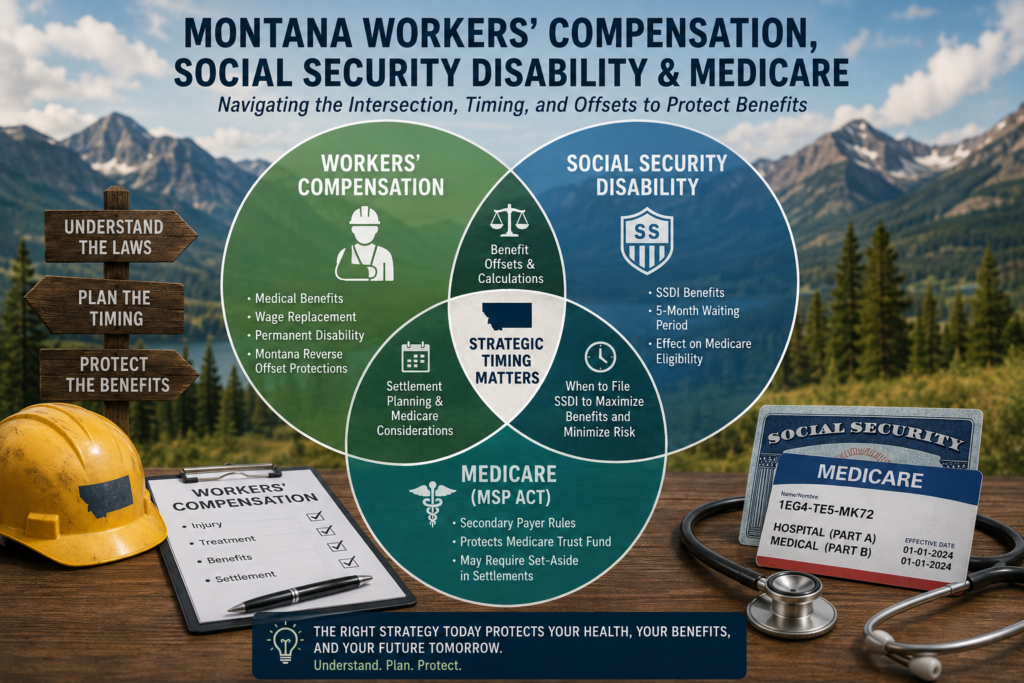
For many seriously injured Montana workers, the workers’ compensation claim is only one piece of a much larger financial and medical puzzle. As injuries become permanent and the prospect of returning to work diminishes, three legal systems begin to intersect:
- Montana Workers’ Compensation;
- Social Security Disability Insurance (SSDI); and
- The Medicare Secondary Payer Act (MSP).
Unfortunately, these systems were not designed to work seamlessly together. Decisions that make sense from the perspective of one program can unintentionally create problems under another. Proper timing—and understanding how these programs interact—can literally preserve tens or even hundreds of thousands of dollars in future benefits.
The First Question: Should You Be Applying for Social Security Disability?
Many injured workers wait far too long before considering SSDI.
The workers’ compensation carrier may continue paying temporary total disability benefits for months—or even years—leading many people to believe there is no reason to apply for Social Security disability. In reality, several facts should prompt an immediate evaluation.
An injured worker should seriously consider applying for SSDI when:
- The treating physician believes a return to competitive employment is unlikely.
- Restrictions have become permanent or long-term.
- The worker is approaching maximum medical improvement without meaningful functional recovery.
- Vocational rehabilitation has been unsuccessful.
- The worker cannot perform past relevant work and is unlikely to transition into other substantial gainful employment.
- The treating physicians are discussing permanent total disability or lifelong work restrictions.
- The claimant has multiple impairments whose combined effects significantly limit work capacity.
Remember that SSDI is not limited to catastrophic injuries. Many successful claims involve combinations of orthopedic injuries, chronic pain, traumatic brain injuries, psychological conditions, cardiac disease, pulmonary disease, or neurological disorders.
One practical consideration is the five-month waiting period for SSDI cash benefits. Because the administrative process itself frequently lasts many months, delaying an application often delays both monthly disability benefits and eventual Medicare eligibility.
Montana’s Reverse Offset Makes Montana Different
One of the most misunderstood areas of workers’ compensation law involves the interaction between SSDI and workers’ compensation benefits.
In most states, Social Security reduces SSDI benefits whenever the combined workers’ compensation and SSDI payments exceed 80 percent of the worker’s average current earnings under 42 U.S.C. § 424a. The Social Security Administration also excludes certain expenses—such as attorney fees, rehabilitation costs, qualifying medical expenses, dependent benefits, and specific-loss payments—from the offset calculation.
Montana is different.
Montana is one of the relatively few jurisdictions recognized by the Social Security Administration as a reverse offset state. Under Montana law, the reduction occurs on the workers’ compensation side for qualifying benefits rather than reducing SSDI benefits, provided the claim falls within Montana’s recognized reverse offset framework. SSA’s Program Operations Manual System (POMS) specifically recognizes Montana’s reverse offset provisions for Temporary Total Disability (TT) and Permanent Total Disability (PT) benefits.
This distinction often surprises claimants. Instead of asking, “How much Social Security will I lose?” the better question becomes:
“Has the Montana workers’ compensation carrier properly considered the reverse offset?”
That question can significantly affect settlement negotiations.
Timing Matters More Than Most People Realize
Perhaps the most important strategic decision concerns when to file for Social Security disability.
There are two competing considerations.
Filing Early
Filing early may:
- preserve retroactive SSDI benefits;
- establish disability sooner;
- begin the countdown toward Medicare eligibility; and
- provide income if workers’ compensation benefits stop unexpectedly.
If the medical evidence clearly establishes permanent disability, delaying an application may simply postpone benefits that otherwise would have been payable.
Waiting Until Settlement
On the other hand, many attorneys intentionally delay filing an SSDI application until after a workers’ compensation settlement.
Why?
Because once a claimant becomes reasonably expected to qualify for Medicare, settlement negotiations may implicate the Medicare Secondary Payer Act and potentially require consideration of Medicare’s future interests through a Workers’ Compensation Medicare Set-Aside (WCMSA).
Delaying the Social Security disability application until settlement has become a common strategy to avoid prematurely triggering Medicare Secondary Payer concerns. At the same time, that delay creates practical difficulties when attempting to document Montana’s reverse offset because the claimant’s anticipated SSDI benefit amount is still unknown.
The Medicare Secondary Payer Act Changes the Conversation
The Medicare Secondary Payer Act exists for one fundamental reason:
Medicare should not pay for medical treatment that another entity is legally responsible to pay.
In workers’ compensation claims, the workers’ compensation insurer is generally the primary payer for industrial injury treatment.
When a claim settles and future medical benefits are closed, Medicare wants assurance that settlement proceeds intended for future medical care are appropriately exhausted before Medicare begins paying for treatment related to the work injury.
This is where timing becomes critically important.
A claimant who has not yet applied for SSDI—and who is not yet a Medicare beneficiary—may avoid immediate Medicare Secondary Payer issues during settlement negotiations.
Conversely, once a claimant has been awarded SSDI, the two-year waiting period toward Medicare eligibility has begun. As settlement approaches, Medicare’s future interests become increasingly significant.
The timing of an SSDI application therefore affects much more than monthly disability benefits. It can materially influence how a workers’ compensation settlement is structured.
The Practical Problem During Settlement
Montana’s reverse offset works best when everyone knows the claimant’s projected SSDI benefit.
But what happens if the claimant intentionally delays filing?
This has become increasingly important following additional scrutiny from SSA.
Some insurers began requiring documentation demonstrating that settlement negotiations actually considered Montana’s statutory reverse offset rather than merely inserting boilerplate language into settlement agreements. SSA likewise has requested documentation supporting the calculation underlying reverse offset language.
One practical solution is surprisingly straightforward.
Rather than immediately filing an SSDI application, counsel can ask the claimant to contact SSA and request an estimate of the anticipated disability benefit amount. That projected monthly benefit can then be incorporated into an exposure analysis and used to calculate the anticipated reverse offset during settlement negotiations. The settlement agreement can expressly state that the permanent total disability component reflects application of Montana’s statutory offset.
This approach provides documentation demonstrating that the parties actually negotiated with the reverse offset in mind.
Not Every Workers’ Compensation Benefit Receives Reverse Offset Treatment
Another common misunderstanding is that every workers’ compensation payment receives reverse offset treatment.
That is incorrect.
Under SSA’s Montana POMS guidance:
- Temporary Total (TTD) benefits receive reverse offset treatment.
- Permanent Total (PTD) benefits receive reverse offset treatment.
- Other benefit categories—including many Permanent Partial (PP) awards, impairment awards, rehabilitation benefits, wage supplement benefits, and settlements that do not qualify as TTD or PTD—may still be subject to traditional Social Security offset analysis.
Consequently, accurately identifying the type of benefit being settled is essential.
Settlement language matters. If there is even a remote possibility of applying for Social Security disability benefits, a workers’ compensation settlement agreement should reflect offset provisions that specifically identify that the offset was considered and applied. Such language should be specific, including rates if possible and not just a wink and a nod referenced to the offset.
The characterization of benefits may affect whether SSA recognizes Montana’s reverse offset provisions.
Coordinating All Three Systems
The best outcomes occur when workers’ compensation counsel, Social Security counsel, and Medicare planning professionals coordinate from the beginning.
Questions worth discussing early include:
- Is permanent disability becoming likely?
- Should an SSDI application be filed now?
- Is additional medical evidence needed before filing?
- Will settlement likely occur before an SSDI decision?
- Will Medicare Secondary Payer considerations complicate settlement?
- Does the proposed settlement accurately identify TT or PT benefits?
- Has Montana’s reverse offset actually been calculated and documented?
These questions become increasingly important as cases approach permanent disability or settlement.
Final Thoughts
The intersection of Montana workers’ compensation, Social Security disability, and the Medicare Secondary Payer Act is one of the most technically demanding areas of disability law.
An SSDI application should never be viewed solely as another source of income. Filing too early can complicate settlement planning under the Medicare Secondary Payer Act. Filing too late may unnecessarily delay disability benefits and Medicare eligibility. Likewise, overlooking Montana’s unique reverse offset provisions can leave substantial value on the table during settlement negotiations.
Every significant workers’ compensation claim should include an early evaluation of three issues:
- Is the worker likely to qualify for Social Security disability?
- How will Montana’s reverse offset affect settlement negotiations?
- When is the optimal time to file for SSDI in light of potential Medicare Secondary Payer implications?
Answering those questions before settlement discussions begin allows injured workers and their attorneys to maximize available benefits while minimizing unnecessary complications. In many cases, thoughtful coordination among these three systems can substantially improve both the immediate financial outcome and the worker’s long-term medical security.
The author, Dean Blackaby, practices in the areas of workers’ compensation and Social Security disability. He has lectured nationally on more than 25 occasions on the topic of compliance with the Medicare Secondary Payer Act while settling workers’ compensation claim and authored two manuals on the Medicare Secondary Payer Act.